
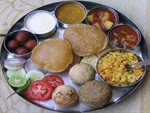
Rarely has the world seen so rich a cuisine from so little that was available from the land. While the eastern region of the state has fertile soil capable of everything from wheat and maize to millets and corn, for much part the deserts dry terrain, prone to droughts, was incapable of producing even basic necessities of survival. Yet live and eat they did, creating an exotic cuisine from the soil that threw up a few pulses, crops of millets and tress with beans that were dried and stored for use when, in the summers, nothing would grow.
Though the Rajasthani kitchen was able to create much from little, it has also to cater to different communities with their own ritual observances. The Rajput warrior’s , for example, were not averse to Shikar, hunting game to put in his pot at night. The Vaishnavs, followers of Krishna, were vegetarian, and strictly so, as were the Bishnois, a community known for their passion to conserve both animal and plant life. The Marwaris, of course, were vegetarian too, but their cuisine though not too different from the Rajputs, was richer in its method of preparation. And even there were Jains too, who were not only vegetarians, but who would not eat after sundown and whose food had to be devoid of garlic and onions which were, otherwise, important ingredients in the Rajasthani pot.
Since the desert’s dry terrain was incapable of producing vegetables, the women of the famly would dry the desret beans, fruits and vegetables like Sangri, Mogri, Gwarphali (types of desert beans), Kair and Kachri (types of desert fruits) that are eatable and palatable and stored for future use, when in the summers, probably nothing would grow. Using onions and garlic, mustard, red-chilli powder and other spices this is cooked with yoghurt.
Gatte-ka-saag:
Chickpea floor paste rolled into a sausage shape, cut into slices and deep fried and cooked in yoghurt and spices.
Badi-ka-saag:
Dried moth lentil dumplings are cooked in yoghurt and spices.
Dana-Methi:
Dana (small pea shaped vegetable) and Methi (leaves of a green vegetable) boiled together and cooked in masala, sugar and some dry fruits.
Chealra-ka-saag:
gram (legume) flour paste, chapatti (flat unleavened bread) which is cut in pieces, fried and then gravied.
Karhi:
It is popularly known as Khatta is the accompaniment common for almost all regions. Made from sour butter-milk, it is mixed with chickpea flour and allowed to cooked with mustard seeds and crushed garlic cloves. The taste depends on the time it is allowed to stay on fire.
Kichra:
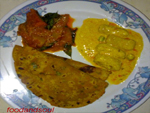 A porridge made using millet grains and moth lentils boiled together in water with a touch of little spices and ghee. It is also state’s farming community night mainstay eaten with jaggery. Another common accompaniment with Bajra rotis and garlic plus red chilli chutney for the working class Rajasthani is Rabbori which is believed to be extremely soothing and cooling in the summer heat, it is millet flour cooked in buttermilk.
 Hot Milk:
Glass of creamy milk topped with pista and lonj.
Puris:
Fried wheaten bubble.
Paranthas:
Unleavened wheat bread repeatedly coated with oil and folded so that when it is cooked its s light and fluffy)
Tamatar-ki-sabji:
A sour and sweet tomato curry.
Daal Bati Choorma:
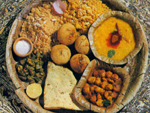 The connoisseur’s delight is Rajasthani speciality – Daal Bati Choorma. This exteremly calorific fat contended meal is the favourite of all while picnicking in the rainy season, usually cookes on the site. The daal is lentilcurry, bati is a round ball of generally wheat bread baked in a charcoal fire with generous amount of ghee applied once its is baked. Masala Bati is wheat Bati stuffed with spices, mawa, peas and dry fruits. Choorma is sweet dish made of gram flour bruished with jiggery or sugar, ghee, cardamom and dried fruits.
Lahsun ki chutney:
It is a popular accompaniment with Rajasthani cuisine – paste made by grinding garlic cloves and red chillies.
Non- Vegetarian:
Sula:
It is the meat (chicken, mutton or fish) barbecued over a bed of live coals. This form was devised by Mewar family.
Safed mass: mutton cooked in curry made of cashewnuts, almonds, coconut carnel paste, white pepper and poppy seeds.
Khada keema: minced meat with whole spices.
Sweets:
Sooji Halwa: semolina pudding in ghee.
Badam Barfi: almond fudge made from sugar, milk, almonds and ghee.
Kheer: rice pudiing with cardamom and saffron.
Mawa-Kachori’s: Jodhpur speciality – puffed breads with stuffing of mawa.
Ghevar: round cakes of white flour over white sweetened syrup is poured and has lacings with cream and mawa.
Feeni: ball shaped sweet made from threads of urad ceral, deep fried and then dipped in sugar syrup.
Rasgolla and Bhujia from Bikaner.
Milk Cake of Alwar.

